

Book of Ryans - Late Mediaeval Time
Chapter Four:
The Late Mediaeval Period
And ages of glory yet, yet shall it see,
And `twill smile to the river and smile to the sky,
And smile to the free land when long years go by;
And children will listen with rapturous face
To the names of the legends which hallow the place,
When some minstrel of Erin, in wandering nigh,
Shall sing that dear Castle more fondly than I.
From "History of EIy O'Carroll"
Mixed farming in the traditional English manner was concentrated in the Pale, south Wexford, Kilkenny and Tipperary, with isolated agricultural communities in other counties such as Waterford and Limerick by 1500. In these areas, the new settlers remained very "anglicized", and persevered to absorb Gaelic peasants into the mainstream of their civilization. As the Gaelic population expanded in the English communities, so did their involvement in the affairs of government. The medieval journals at the turn of the 16th century recorded numerous references of native Irish men being drawn into the bureaucratic structures. Although the vast majority of office holders were men of English extraction, the native Gael, including the Ryans, held public office and appeared prominently in the king's registries as this example demonstrates[1]:
Chief Rembrances (East 1528) - John Ryan
Treasurer's Clerk, Office of Exceequer - John Ryan,
20-Jan-1537
Where the English Pale and populated river areas had by all appearances a formalized government and social stability, the rest of the country remained much as it had for the past few hundreds of years. Large areas of Ireland were covered by scrub forest, lakes, and undrained bogs. The population was small, and in many respects, a nomadic one. The economy was fundamentally pastoral, with cattle and horsemen wandering over great spans of wasteland. Because of this geography, many peasants left their homes and lived in temporary huts while they followed their herds through rough pastures, woods or mountains. Even though this life conveyed a nomadic appearance, the movement of herds was structured, and the settled communities remained the center of the Irish social system. The English commenced challenging the established social conditions inside the Irish wilderness, and one of its first tasks was to contest the legitimacy of land titles held by the native Irish. The intent of these confiscations was to dissolve the recognized Gaelic lordships and replace this authority with men of English descent. Ireland was governed by nearly 100 monarchs (there are some claims that this may have been as high as 200) during the late mediaeval period, and the peoples under their command recognized no other authority, including England's law. It became difficult for England to interject its own prerogatives, and as the document from the Memoranda Roll of Henry VIII showed, questions to valid land deeds filled the rolls as early as 1506:
enrolment of exemplification of proceedings on information by the King's surjeant in King's bench, 1506, against Thomas Ryan of Dunboyne, husbandman, in possession of land without the king's license. A jury found that he was an Englishman.[2]
This land acquisition process would be implemented several times before the century ended, and in each case it stirred the general population to revolt. Over time less land would be owned by men of Gaelic birth as the English devised new means to steal their ancient possessions, and they justified their actions by seizing lands from suspected insurrectionists, with many charges being fabricated, to prevent them from financing political and military challenges to these confiscations. The power of the Gaelic lord eroded as their landholdings diminished; subsequently, they would become more dependent upon the authority of the English Crown and the Anglo-earls who dominated them.
During the late mediaeval period, Gaelic Ireland was not a closed and well-defined arrangement set within a specified territory, but rather one defined by a series of rights and tributes that entitled the title holder with certain benefits. Gaelic lordship was a lordship of men not land, and hence a chief's country was defined by his ability to extract payment or tributes from outlying border clans. This was true for most of the lordships of Munster, but differed in the North as one historian noted: "lordships were generally fragmented and more militarized, than in the Gaelic north and west where lordships were normally solid blocks of territory."[3]
The local kings were the most dominant political influence in the first half of the 16th century. Though the great earldoms were controlled by lords of English descent such as the Butlers and Fitzgeralds, the majority of the land and its peoples were under the dominion of Gaelic kings and princes. If power is measured by the control it has on the population and its institutions, then England possessed nominal influence outside the Pale with the exception of a few Munster Anglo lordships. The general population probably fathomed no other king than the local prince, and the ministers of the Catholic church were more sympathetic with the local lords than with England. The Catholic hierarchy became more vocal after Henry VIII broke away from Rome early in the 16th century, and it made it more difficult for unification with England to occur.
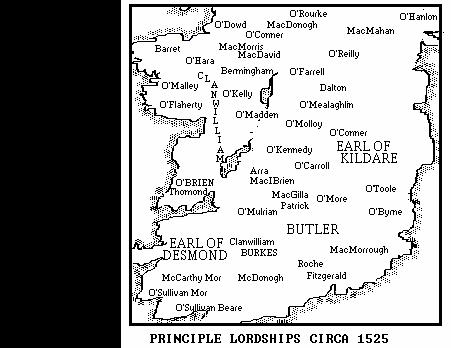
A well-known document reported on the state of Ireland in 1515 divided the Irishry into slightly more than 60 countries each ruled by a chief captain
"And every one of them liveth only by the sword, and obeyeth no other temporal person, but only to himself that is strong. And every other said captain maketh war and peace for himself, and holdeth by the sword, and hath imperial jurisdiction within his own room <or, territory>, and obeyeth to no other person, English ne Irish, except only to such persons as may subdue him by the sword."[4]
In early English idiom, the term "country" actually defined an Irish Lordship. Each country was guided by a Gaelic prince, or as the English called a Captain, and the King's representatives made treaties with these captains on indentured terms with the Crown of England. Few documents exist today showing indentured covenants between the captains and their overlord, but the relatively few surviving agreements suggested it was widely accepted. The term 'captain' was first acknowledged in 1350 when Sir Thomas Rokeby established treaties with Irish chiefs living near the hills of Dublin. As Emily Hahn commented later: "this was the first official recognition of Irish captaincies made by an Englishman, but afterward it was often imitated, up to the end of the sixteenth century."[5]
The tone of the 1515 document also implied that warfare was constant, but historical evidence demonstrated this to be further from the truth. The archives contain a wealth of information concerning these wars with historians such as McGeoghegan, for example, writing that "war was the ruling passion of this people,"[6] but Eion MacNeill later wrote that the Irish were not barbaric warriors as the historian MacGeoghegan commented. MacNeill supported his hypothesis by saying: "Of war, in the ordinary sense, there is no instance in Irish history before Strongbow's campaign in Leinster. The word bellum was frequently referenced in the older annals, but it always meant a single battle."[7] Generally, the Irish troops did not remain in the battlefield for more than several weeks, and battles usually were waged in terms of hours and not days. Military conscription was limited to the landed men of the province and their relatives, and persisted until Tyrone, earl of Ulster, enlisted the aid of the peasants during the rebellion of 1599. Contrary to popular fiction, war was not a prevailing passion in Ireland and only amounted to a small portion of Irish history; however, the poets and bards spent a great deal of time enumerating these battles through song and poetry, perhaps as one historian suggested that, "The bards best work was war songs and war histories."[8] While half of the Irish kings may have been killed in battles or through internecine strife, nevertheless great wars were few.
A glance at the sixteenth century the Fiants and other State Papers indicates that the following were still referred to as chiefs: MacArtan, MacAuliffe, MacAwley, MacClancy, MacDonagh, MacGeoghegan, MacGilpatrick, MacGuiness, MacGuire, MacKenna, MacKiernan, MacKinnawa (Ford>, MacLoughlin, MacMahon, MacManus, Macnamara, MacRory, O Boyle, O Brenna, O Byrne, O Cahan, 0 Carroll, O Connolly,O Daly, O Dempsey, O Doherty, O Dowd, O Driscoll, O Dunn, O Ferrall, O Flaherty, O Folane, O Gara, O Hagan, O Hanlon, O Hara, O Heyne, O Keefe, O Kennedy, O Loughlin, O Madden, O Mahony, 0 Malley, O Hannin, O Melaghlin, O Molloy, O More, O Mulryan (Ryan>, 0 Mulvey, 0 Phelan, 0 Reilly, 0 Rourke, 0 Shaughnessy, O Sheridan. This is in addition to the Mac Carthys, 0 Donnels, 0 Neils, 0 Connors, Mac Quillin, MacMorough Kavanaghs, 0 Briens, MacDermots, McGillcuddys, 0 Gradys, 0 Donovans, 0 Donoghues, and 0 Sullivans. This is a few more than the 60 mentioned in this 1515 report.
Early Conditions
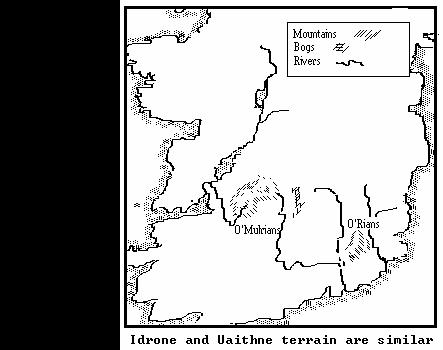
One of the more significant episodes of the early 16th century was a struggle between the chiefs of Munster and the earl of Thomond. This episode in Irish lore placed both chieftains Cnoc Taugh in 1504, and the annalists described it as the fiercest bloodshed since the early post-Gaelic Revival years. They expropriated three castles in Hy Many which forced Melachlin O'Kelly to seek help from O'Donnell, an ally of the Earl of Kildare. The earl of Kildare along with Aedh Rua O'Donnell, O'Conor Rua, MacDermot, the Irish of Ulster, O'Reilly, O'Kelly, O'Farrell, O'Conor Faly, and the Mayo Burkes formed an alliance to stop the advancing armies led by Ulick Burke of Clanrickard and the other Munster chiefs including Turloch son of Taig O'Brien, Ely O'Carroll, and the chiefs of Ormond including the O'Mulrians of Owney.
Ulick Burke sustained severe losses, especially among his trained fighting units. His gallowglass warriors represented the core of his military force, but the ferocity of the battlefield devastated his army, particularly his gallowglasses which had suffered the greatest injury. These Scottish mercenaries formed nine battalions of Clanrickard's forces; and only one small portion of this battalion escaped alive. Shortly after this slaughter, Lord Bormanston said to Earl Garrett, "We have for the most part killed our enemies, and if we do the like with the Irishmen that are with us, it were a good deed."[9]
A few years later another alliance of Gaelic chiefs joined forces. A great war arose between O'Donnell <supported by MacWilliam of Clanrickard and the English and Irish of Connaught>; and O'Neill <supported by the O'Briens, O'Kennedys, O'Carrolls, O'Mulrians, and the O'Dwyers>. These armies faced each other at Knockbui, but as with most Gaelic wars it was short-lived leaving O'Donnell the victor. The surviving members comprising O'Neill's army, as acknowledged by the ancient historians, were allowed to return home after leaving hostages to the O'Donnells. The practice of executing captured or conquered soldiers was introduced by the Normans; but while the Gaelic code honored their warriors, the English merely saw them as future enemies which could potentially return to the battlefield.
In other areas of Ireland, there was tremendous confusion with the English solution for resolving the island kingdom’s problems. The Anglo Earls' domination of the interior regions weakened after the earl of Kildare abruptly returned to England in 1519. His sudden departure made it difficult to collect rentals from his subjects whose lands were ravaged by war. Even in normal times it was arduous to collect assessments, but the extent of destruction in the countryside made it more troublesome because as one witness observed, "The land was much waste and the people marvelously poor."[10] Irish societal harmony deteriorated because of this deprivation, and the country was again exposed to further dissonance. England began tightening her grip on the legislative mandates of the Irish parliament, and she also began demanding stricter loyalty from Ireland's lordships. What started as a demonstration of dissent catapulted into a Gaelic war of independence as the Gaelic Chiefs threw their support to the earl of Kildare who by this time returned to Ireland. The Gaelic captains viewed England's mandates as challenges to their authority, and their fears were warranted because even Thomas Cromwell at this time asked, "Whether it shall be expedient to begin a conquest or a reformation."[11]
This revolt, considered to be the first real Irish rebellion, had its genesis in the Pale when Lord Thomas Fitzgerald, also known as Silken Thomas because of the silken garments he and his bodyguards wore, went before the Dublin parliament and publicly renounced his allegiance to Henry VIII. Fitzgerald had a very cool relationship with the English monarchy as his father was imprisoned by Henry a few years earlier, however, Thomas began to hear rumors of his father's death which greatly upset him. Fitzgerald's passion led him to assemble an impressive array of Gaelic and Anglo-Irish earls who also objected to England's imprisonment of his father, the ninth earl of Kildare. He led this assemblage of men to several victorious conclusions, but eventually Thomas surrendered with an assurance from Henry VIII that he would be pardoned. The King summoned Silken Thomas to England to discuss peace, but Henry's real intent was to ensnare the unsuspecting rebel and have him executed for his treasonous activities.
The forces of Henry VIII eventually brought the rebellion under control, and his Irish councellors attempted to impose oppressive conditions as a means to discipline the Irish. They persuaded Henry that the Gaelic chiefs would only be impressed with the strength of his army, and suggested that the time was ripe for a complete conquest of Ireland. Henry was persuaded by their compelling arguments, so he began a policy whereby he would regrant each Captain's dominion in return for swearing allegiance to the Crown of England. After the Irish lords pledged their fidelity to Henry and returned their lands to the crown, he offered them back as feudal grants. For those lords whom were disposed to challenging the Crown's authority, Henry bound them to learn English, cease wearing traditional Gaelic wardrobes, and discontinue sporting the glib hairstyle and long mustache which symbolized their independent ways.