

Book of Ryans - Late Medieval Period
Many of the treaties drafted by Henry's deputies were formed with petty lords such as the O'Ryans and O'Mulryans. Under these changes, the old laws were eliminated and replaced by English laws which Henry knew would create objections by the tribal chieftains. He distributed land in a feudal manner which prevented common possession by all members of the clan. Ownership was created through an agreement signed between the king and his vassal, and the vassal was to be the principle landowner. The land which was owned by all now became the property of a few.
Henry's plan also included the dissolution of monasteries in Ireland. It was his belief that the Catholic clergy was responsible for the civil unrest in Ireland. A well known report in 1515 complained that none of the clergy preached the gospel 'saving the poor friars beggers'[1] and cited a revelation that of 'all Christian lands Ireland had most continual war, root of hate and envy, and of vices contrary to charity, so that Irish souls `fell down into hell as thick as any hail showers.'[2]
Henry presumed that in reducing the monasteries, the Dublin government would be able to maintain law and order, most notably in the counties of Wexford, Tipperary, Waterford, and other remote regions of Ireland. By the time Henry died in 1547, more than half of the monasteries were dissolved and slightly less than half of the communities of mendicants.[3]
These dissolutions accelerated after Henry VIII broke away from the Catholic church. He demanded that his subjects give up their Catholic faith; however, he found that the Irish were "loyal to the Church of their fathers, to the faith of Patrick, the faith of the Roman See."[4] Henry saw this as an act of treason and began expediting the closure of monasteries in 1536, and in the process divided the land grants held by these church centers among the Irish and Anglo-Irish laymen at certain rentals. These rentals created a total revenue of 4958 Irish Pounds in 1537 and 7458 Irish Pounds by 1542.[5] These reprisals by Henry and subsequent monarchs only heightened the native Irish's perception of the meaning of Protestantism in Ireland. Again as Emily Hahn recognized:
"Inevitably in the Irish mind Protestantism appeared to be merely another aspect of English oppression. An Irishman might be intimidated into accepting the new religion, but his secret allegiance to his own Church became the more fervent for this necessity."[6]
The closing of the monasteries angered many Catholics in Ireland, but the shock was never greater than when the government in Dublin ordered St. Patrick's crozier burned in the streets of this Irish capitol. This inexcusable act alienated the Catholic population; and rather than seeing wholesale conversion to Henry's newly organized religion, the general population, along with its gentry, were driven closer to the Church for guidance.
The Fiants of the period recorded a grant to Dermot Ryane of Tipperarie, gent, in consideration of the sum of 6 Pounds 13 Shilling and 4 d. For this payment he received the monastery of Franciscan Friars of Kyllallo, County Tipperary.[7] With this grant, he was able to hold forever this property by the service of a twentieth part of a knight's fee (men for military service or tribute) and an annual rent of 4 pence. Another grant was made to Dionysius O'Mulryan of the late house of the B.V.M of Cahyr as pension. The records also confirmed a lease made to Dermot Ryan of Cashel for the monastery of Kyllally with appurtenances to hold for twenty-one years at a rent of 48 pence.[8] This grant to William Ryan included the appurtenances in Tipperary and Cloghfade, "to hold for ever by service of a 48th part of a knight's fee and a rent of eight pence."[9]
Though many religious orders were closed, the priesthood continued to flourish throughout the sixteenth century. The pre-Reformation clerical occupation became increasingly hereditary in character despite earlier reform movements to prohibit this type of abuse. Hereditary occupations were commonplace as one of the O'Mulryan neighbors, the O'Heffernans, possessed the Abbey of Holy Cross and passed the title from father to son. Careers in the priesthood was not limited to specific family groups, and as the 16th century progressed greater opportunities for 'outsiders' in the religious orders expanded. The O'Mulryans also became more noticeable in ecclesiastical matters, and their role within the Church was highlighted in several records of the period:[10]
A charter for the abbey of the B.V.M of Wethenia (Owney), diocese of Emly of the Cistercian order with the assent of James, Earl of Ormond, its founder and patron; transferring it to a secular provosty; John Ryane, late abbot to be provost.
John Fyan (Ryan), confirmed to vicarage of Laragh-Bryan 1536.
Presentation of Donogh Ryan as chaplain to the deanery of Emly; Richard O'Brien and William 0'Hurnly occupying by the authority of the bishop of Rome.
Presentation of John Ryan, clerk to the vicarages of the cathedral church of Imely and of the parish church of Cullen, diocese of Emly, vacant because the late incumbents, Dermot O'Cahill and Riery O'Hiffernan were of the Irish nation. This church is identified as Imolacon and of the parish church of Cullen, Imolacen dioceses, 1549.
1551, John Rian, perpetual vicar of the Cathedral Church de Imely and de Cullen, Imolacens dioceses, noted in Dublin February 15.
Presentation of Donal Rean of Solchoid, clerk to the prebend and vicarage of Lattyn, diocese of Emly, because Malachy O'Duylla, late incumbent was of the Irish nation. Donald Ryan, prebend of Lattin, Cuirealiter vicar ejuse est. annex, Imolacens, dioceses.
Presentation of Donald Rean of Solchoid, clerk to the rectory of Cromye (Croom> diocese of Limerick, vacant by the death of Thady Read and usurped by William O'Hurnly.
Confirmation of Donald O'Mulrian in deanery of Emly (1540), the rectories of Brivis and Kilaryll, the vicarage of Nayra and part of Kilbeakayn.
Dermut O'Mulrian confirmed to the archdeaconry of imlar, December 1, 1560
Mulryan als. ryan (Thomas, confirmed to the chancellorship of Imalacen, June 15, 1562.
Cornelius O'Mulrian confirmed as a deacon at Emly, 1559. This same Cornelius O'Mulrian would become Bishop of Killaloe and Dublin before the end of the century (this was not identified under the 'Remaining of Record on the Patent Rolls of Chanery in England'.
The Church in Gaelic Ireland exhibited unique characteristics from that of late medieval Catholicism. Clerical celibacy was widely ignored despite legislation prohibiting marriage, and the clergy members were frequently kinsmen and dependents of the ruling chief. Even among the Ryans this was true as records showed that Cornelius Ryan (O'Mulrian) was bishop of Killaloe in 1576 while his brother was 'the O'Mulrian', Chief of Owney.
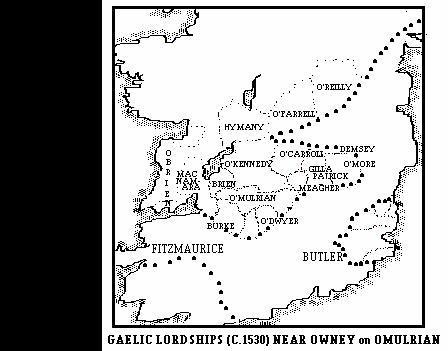
The Anglo-Irish lords after 1535 supported numerous expeditions into Gaelic Ireland, and their service was designed to prevent English kinsmen from further terrorizing the countryside. Even the government's attempts to arbitrate the problems between rival tribes was ineffective; consequently, new reform measures were developed and instituted. To enforce these new procedures, Lord Leonard Grey was appointed to handle Thomas Cromwell's administrative reforms; and as chief justice he was responsible for upholding law and order in the Irish wilderness.
Grey became involved in an unusual arbitration attempt in 1538 between James Fitz John and Lord O'Mulrian of Owney. James Fitz-John ruled a large palatinate in Tipperary and Kerry, and his authority went unchallenged because, as supreme lord of the palatine, its laws were mandated by him. When O'Mulrian of Owney sought Deputy Lord Grey's assistance to recover property taken by Fitz-John, it led to a curious standoff between the two strong-willed English noblemen:
O'Mulrian of Owney, or Abington, near Limerick, owed the Deputy forty marks, and to secure the payment put a pledge of cows into the hands of James, Earl of Desmond. O'Mulrian paid the Deputy his forty marks and naturally went to look for his cows. James would not surrender them, whereupon O'Mulrian applied to the Deputy, who insisted upon James delivering up the pledge. "You are paid," said Desmond. "You have no further interest in the affair." Thereupon the two "began to square together," and all the men were drawn up in preparation for a fight. Friends intervened, however, and seemingly induced Desmond to give up the cattle.[11]
Desmond's attempt to extract a tribute from O'Mulrian failed because Grey was determined to institute Cromwell's reforms in Ireland. Grey's insistence to establish English policy distanced Fitz-John from the lord Deputy, and Fitz-John's stubborness to reconcile with the lord justice would later undermine his ability to remain unchallenged in the palatinate.
James Butler, after the death of his father, became the earl of Ormond in 1539, and one of his first tasks was to reclaim portions of his lordship which had, over the years, been taken by Fitz-John of Desmond. Ormond enlisted the help of Lord Grey, and with their combined armies marched into Munster to retake castles from the White Knight, McBrien Arra, the O'Dwyers and other captains.
Lord Grey's army rode virtually unchallenged throughout the countryside in 1539, and with little opposition was able to bring most of the septs to order. Grey was a skilled military man, and with artillery wheeled over difficult terrain, destroyed O'Connor's castle, attacked the MacMahons in Farney, and journeyed through Armagh and Munster seeking the subjection of Irish chieftains. Among his prime objectives was to force the Ryans of Owney and Kilnemanagh to submit to English authority, and after launching a military endeavor throughout Tipperary he was able to subdue the troublesome Ryans. A letter from the Earl of Ormond to Thomas Cromwell disclosed that Dermot O'Mulryan of Owney and Shane Glasse O'Mulryan of Kilnalongurty submitted, promised to be faithful to England and pay the Crown an annual tribute:
"Modreeny, thither came to his lordship hostages of Mc Brene Arry, O'Kennedy, Dermot O'Mulrian and O'Dwyer, both to be faithful and to pay the King's highness certain yerlye trybute. and 500 from there came to one Shane Glasses <O'Mulryan's> country, being the chief guyde that O'Brien had in the country, who afterward departed. And 500 returned to a house of myne called Thurles, resting there two nights where cam to my Ld. Dep's hands their pledges."[12]
Gaelic chiefs suing the deputy for peace agreed to unreasonably severe terms by way of tribute and homage; moreover, Grey's actions convinced the chiefs that he and the English government he represented intended to destroy Irish culture. The chiefs saw Grey's aggressive enforcement of English laws as the first step towards total conquest, but Henry VIII never actually believed that Ireland could be defeated militarily. He contended that negotiated settlements would be more effective in persuading the Irish to join England peacefully, and wrote that it should be done "by sober ways, politic drifts and amiable persuasions founded in law and reason."[13] Grey's attempts to bring order to Ireland was applauded by English conservative elements who felt that the chiefs would be "brought to no good order, unless it be by compulsion."[14] Munster was again quiet, and for those chieftains who surrendered to Lord Grey, pardons were issued on their behalf. Some of the O'Mulrians among this list of pardons included
Pardon to Master Dermot O'Mulrian and Donald O'Mulrian of Solchoid, clerks and bachelors of law, John and Dermot O'Mulrian of same, clerks, Donald O'Molrian of the monastery of Uathine (Owney), County Limerick, clerk, Sir Dionysius or Donat O'Mulrian, bachelor of Canon law, pardon to Rory 0'Molryan of Thurles, chaplain, pardon to Thady M. Philippe O'Mulriane of Bolyike, Donald M. Reyry O'Mulriane of M. Kenye, Donald, Diermode O'Mulriane of Kilmacowege, and other O'Mulryans, Reans and Ryans.[15]
The policy of 'surrender and regrant' issued in 1540 marked a fundamental departure from the traditional relationship with the Gaelic lordships. Cromwell envisioned a special legal code for the Gaelic and border Captaincies which used a combination of Brehon and English customs. To meet this end, the Gaelic chiefs were induced to hold onto their lands through feudal arrangements, and the King would forego any claims on their territorial possessions. Because the great lords surrendered their lands to the Crown and received them back as feudal assignments, it provided a guarantee of their loyalty since their lands would forfeit to the Crown if they proved themselves disloyal. The earls of Desmond and the Burkes of Clanrickard brought all the major Gaelic lords to terms between 1539 and 1540, including Dermot O'Mulryan in 1540. Each of these major chiefs bound themselves to indenture, and recognized king Henry as lord. The Gaelic lords applied for a grant from the Crown for lands, and received from the king a claim to peerage. Their legitimate titles allowed them to attend parliament, and would allow them nearly absolute control in their province as long as they resisted papal jurisdiction. The terms agreed upon were different for each chief as marked by Dermot and his entry:
1540 Indenture between the King and Dermot
O'Mulryan, captain of the country of
Owney who was to pay 48/- and to find
for a month 68 gallowglasses.[16]
As feudal claims were being granted, an increasingly vocal contingent believed that segments of their lordships were being usurped by their peers. One such complaint was registered in the 'Patent and Close Rolls Calendar' against the Burkes, and the Commissioners ruled that the lands around Sologhead and Monysheane Twiney legally belonged to the O'Briens. The Commissioners also ruled that "Master Derby Ryan of Solchoyte, and their lands were under the rule of the Bryens and 'his nation'."[17] The property owners' complaints intensified as other land grants were being contested, and more often than not these disputes led to bitter, and frequently deadly, consequences.
In 1542 the Lord Deputy issued a proclamation to reform the 'wild Irish of Munster'. One piece of this proclamation limited the size army that the 'mere Irish' could maintain, and Cromwell's laws further attempted to regulate the daily affairs of the Gaels including their admittance to the local towns. The English hoped that by regulating the Irish nobility and bringing them into compliance with established English customs that it would help stimulate commerce between the remote villages of the Irish interior. Merchant pack trains were constant prey to roaving gangs of Irish kerns, and trade routes between Limerick City and Cashel, for instance, were especially vulnerable as the road went through several 'untamed' Irish countries including Owney-on-O'Mulryan.
By the time Henry VIII died in 1547, England controlled at least half of Ireland including 48 of the most important lordships, both Gaelic and Anglo-Irish. During most of this period, Irish civil authority was dominated by the English parliament; though there were many indications that a policy encouraging criminal retaliations toward the native Irish was being nourished through this authority. One of the inexcusable mandates created during this period was the Act of Absentees which attempted to reduce the native Gaelic chiefs of their authority, yet the lordships of Ireland eagerly embraced its mandates even though lords such as Sir Francis Bryan stated that he would not "borrow of the law as my lord of Ormonde did."[18] England's preoccupation with certifying the legitimacy of ancient Gaelic land titles alarmed hundreds of Gaelic gentlemen including the Idrone Ryans because they could not produce adequate evidence proving that their ancient patronage belonged to them. The Ryans of Carlow approached lady Ormonde "offering to convey their lands to her and her heirs"[19] as a means to protect their claim, and although they greatly feared this ruthless aristocrat, they feared losing their lands more.