Book of Ryans - Late Medieval Period
Between 1547 and 1591, civil and religious authority was suppressed by the introduction of penal laws forbidding the exercise of religion, access to education, and loss of other personal freedoms. It was observed that, "All over the kingdom the people were left without religious worship; and under pretence of obeying the order of the state, they seized all the most valuable furniture of the churches which they exposed to sale without decency or reserve."[1] These penal laws alienated the native Catholic population from the newly emerging Protestant aristocrats of mother England. The historical significance of these social divisions is reflected by a tale concerning Captain O'Mulrian's visit to Lord Firmount's house at Terryglas Parish:
An English family named Firmount, came to live here. They removed an old castle of Garrycloughey, and built on its site a residence, which, at present is a ruin. At one time the descendant of the old Milesian family of the O'Ryans of Owney, near Nenagh, a Catholic, came on a visit to the Firmounts, with other guests, who were protestants. One of the guests made use of language offensive to the Catholic religion, when O'Ryan drew a pistol, and presented it at this person; Firmount, who was a friend of O'Ryan, sprang between the parties and received the shot, which killed him immediately. It is stated that the heir had married a Catholic, and became a Catholic, on account of which he was disinherited by his father.[2]
In a letter written to Henry VIII from the earl of Ormond, the earl noted that civil unrest was particularly vigorous within his Lordship. He wrote that the O'Carrolls convinced others in Ormond to rise up against the unpopular precepts, and that one of his subjects, Ferganism O'Carroll, murdered William O'Carroll, Brian O'Kennedy, and others including servants of William who allied themselves with English authority. The Earl wrote that Ferganism would destroy the peaceful climate of Ormond, and he was encouraging other lesser lords to disregard English dictates:
The said Fergananym being the earl of Kildare's son-in-law, hath been one of the chief captaines of the traitor Thomas Fitzgerald <Silken Thomas> in all his rebellion; and is strongly joined by marriages to O'Brien and James Desmond; and so, consequently, a scourage and an oppressor of those in his quarters, that served the king's Majesty in that rebellion. He doth daily what he can to destroy the sons of the late O'Kerroll, and, also, the Kennedys, O'Dwyers, O'Mulryans, and the O'Meaghers, who served the king, and took His Grace's part in the late rebellion.[3]
Although settlements were made to entice the Irish lords to peaceful settlements, the king's representatives persevered to repel rogues "who for the more part, will steall, rob out of churches or elsewhere."[4] One of the more notorious gang of bandits that roamed Ireland lived in the wilderness of McBrian Ara and Owney-on-Mulryan. These thieves, known as the 'old evil children', were the illegitimate sons of Terence O'Brian, the deceased Bishop of Killaloe. A message sent to the King regarding their plunderous activities declared that, "The old evil children - by reason whereof few or some of your Grace's subjects in effect could pass or travel between your Highness's cities in Limerick or Waterford but they were either spoiled, robbed, or killed in your highway betwixt both cities."[5]
The deterioration of the Irish lordships ultimately led to another, albeit ill-fated, uprising that erupted in the South in 1548 when the O'Carrolls went on the offensive against the Norman settlers. They raided north Munster, and burned the entire town of Nenagh and the monastery outside the fortress of Nenagh. After Nenagh's destruction they proceeded into Uaithne, and drove out its English settlers which created great confusion among them. O'Carroll, while in Owney, burned the monastery in Abington which by this time was patronized by prince Ryan and his family. It is probable that the 0'Kennedy's and 0'Mulryans participated in these events, perhaps initially defending their lands, but later, as references indicate, switched their allegiance to support the Gaelic O'Carrolls. This change of position was referenced in the Carew MSS, dated May 8th, 1553. In his journals, Carew mentioned that "between Limerick and county Tipperary be these Irish-men of good power, the McWilliam Mc Brene, O'Gonaght, Mc Brien Ara, O'Molryan with diverse others, which within a few years were all wild and not conformable to any good order. Yet they be now ordered by the sheriffs of the shires, so as men may pass quietly throughout these countries at pleasure without danger of robbery; each of them lieth in his own country quietyly without hindrance of others. Other Irishmen's countries betwixt that and upper Ossory as O'Kennede, O'Dwyer and the Carrowles doth bear gallowglasses to his Majesty without contradiction which were wont to be mortal enemies of the English rule."[6]
|
|
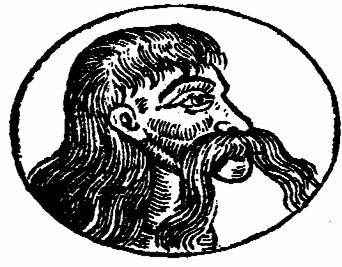
The Gaelic population demonstrated their resistence to English rule by wearing forelocks and sporting a long mustache which during the 16th century were outlawed, although most natives igorned these laws. 'De Hibernia et Angiquitatibus eius by Sir James Ware, 2nd edition, 1658. |
The earl of Ormond
After the accession of Elizabeth to the throne of England, Thomas Butler became the tenth earl of Ormond. Thomas was born in 1531, and was commonly called "Black Thomas" because of his dark hair and facial features. Public records of the period also referred to him as 'Tom Duffe' as well. He was 26 years of age when he arrived in Ireland, and unlike his parents was brought up in the Protestant religion although he confirmed to Roman Catholicism for a short period during Mary's reign. Black Thomas played an important role in 16th century Ireland by becoming a mediating factor in Ireland, and he guided his countrymen to make peaceful terms with England. His popularity among the Gaelic lordships was well known, yet he would never waiver of his support for the Queen or her Court.
Butler was greeted with enthusiastic welcomes in Kildare even though he dressed like an Englishman. He was undoubtedly very wealthy, and considered to be more provident than others during his lifetime. A verse describing his life in Munster idealized his altruistic virtues.
He took Raghlin in the land of Alba. After hard-fought combats, a pretty of cattle; Thrice he set Glen-Concadhain on fire, This wealthy and tender-hearted chieftain. He left no herds around Loughneagh, The seer so provident and bountiful.[7]
Even though Thomas Butler was quite young when he became the earl of Ormond, he recognized the political realities of developing relationships with his Gaelic subjects. He was aware of the significance of the ancient Brehon custom of fosterage, and used it effectively with the O'Mulryans in 1557. Thomas signed the treaty with O'Mulrian and his brother, and "one of the conditions was that he should give them the first son or daughter to be born to him in fosterage."[8] The ancient custom of fosterage created a contractual arrangement to legally "adopt" children for the purpose of developing future alliances, but its most signficant element was that it provided political clout for the fostered family. The earl of Ormond also benefited from this relationship because it ensured future support from Shane Glas O'Mulryan's sept of Borrisoleigh.
Several years later, in 1559, the subordinate chiefs within Ormond were embroiled in another disagreement, and sometime during the year the O'Carrolls led an expedition against Mac-I-Brien of Ara, both of which were the 0'Mulryans neighbors. The Four Masters states that the "O'Carrolls at once devastated and totally ravaged the country from Bel-an-atha to Muilleain-Ui-Ogain."[9] The Four Masters goes on to say that the Mac-I-Briens assembled their friends and raced onto Ely O'Carroll to avenge the deaths of their friends and relatives. O'Carroll observed Mac Brien's armies entering his country and recognizing their lack of military strength, marched his men in fighting order and crushed Mac-I-Briens forces. The Ryans of Sologhead were traditional friends of the McBriens, so it is likely that they joined them in their campaign where "Every man of Mac-I-Brien's people able to bear arms was slain."[10]
The relationship of the Borrisoleigh Ryans to the Ormond earl shows how entangled the alliances had become. Their closest relatives, the Ryans of Owney and Sologhead, were historical allies of Desmond; and the contentious relationship of the Desmond and Ormond lords certainly pitched these two family units against one another. Ormond disputed Desmond's claim of several baronies along the Limerick and Tipperary borders, and Desmond's unwillingness to yield these lands exploded into a decision to meet each other militarily near the city of Tipperary. Desmond's army included most of the chief lords and captains of Munster including the septs of West Limerick and Cork, which were usually described as "the local septs of Ryans, Heffernans, Quirkes, McGraths, etc."[11] Ormond's forces were manned by the principal west Tipperary septs including the O'Dwyers of Kilnemanagh, whom were traditional allies to the Butlers, and possibly the Ryans of Borrisoleigh. The two armies met each other on the hills of Corroge, but through the intervention of Desmond's wife (she was also Ormond's mother) and a few neutral friends, the two earls disbanded their armies and sent them home. The confrontation was avoided, but the Anglo earls' feud stimulated England to press for further mechanisms to control the wild Irish.
English administrators decided to reauthorize the scrutiny of Deeded titles in 1560, and by the end of the decade Munster, in particular, was flourishing with English fortune hunters contesting shaky land titles. One of the more infamous land pirates was Peter Carew, a Devonshire gentryman, who was to play an important role in later rebellions. He used his genealogical roots to Robert Fitzstephen, one of the 12th century invaders who accompanied Strongbow, and subsequently acquired vast estates in Carlow and Meath and later, through unusual circumstances, thousands of acres in Cork, Waterford and Kerry. His acquisition of lands from ancient lordships was not unusual, as records showed that many Englishmen plundered Leinster and Munster for titled estates including Richard Grenville, Warham St. Leger, and Humphrey Gilbert. This 'genealogical buccaneering'[12] was one of the principle causes for the discontent which erupted several years later under the guise of a 'religious revolution.'
Coyne and Livery
The use of Coign and Livery was widely used by the Anglo-Irish and Gaelic chieftains even though English law prohibited its use. Coign and Livery was the extraction of cattle, horses, and food to feed the armies during times of crisis. Spencer simply stated that "by the word livery is meant horse-meat, like as by the word coigny is understood man's meat.'[13] The extraction assumed a repayment; however, if the extractor failed to defeat his enemy, a repayment was never rendered. The complaint surrounding the exaction of Coyne and Livery had surfaced almost from its inception, and an early 16th century author suggested that it taxed the very groups which delivered prosperity to Ireland: "...there can be no more industrious people under the sun than their churls and husbandmen, if their lords do not eat them out."[14] Coign and Livery was originally introduced by Maurice Fitzgerald during the reign of Edward II as a means to finance an army to stop Edward Bruce's advance in central Munster. Because it was frequently used to underwrite a great lord's military appetite, landowners such as Donad Ryan contested its use, but since English law was often disobeyed it is uncertain what positive effect this ruling may have had.
Donad Ryan als O'Mulrian and Eustace English of Solchoidbegg, gents, it was ordered that the complainants, their heirs and assigns and the tenants and followers shall be free from hence forth and discharged of all exactions called Connyes, Liveries, Coshiers, coddies, gallowglasses, Marquebussiers, Pillin fallowes and other impositions whatsoever of any the Lords, Rulers or other their neighbours, bounding upon them of a yearlie rent of 13/4, due to the chief of the Burkes.[15]
A few years later the governor of Munster, Sir Humphrey Gilbert, was determined to control the earldoms of Munster. He received pledges from each chief as an assurance of their good behavior, and to ensure proper conduct, he outlawed coyne and livery for all persons living inside Munster. The chief landholders were to provide names of their soldiers whom were under their command, and were compelled to accept a provost marshall to monitor the valuables of the English. Their principal activities were to control the movements of the lower segments of the economic chain including houseboys, woodkerne, and revolutionaries. By outlawing Coyne and livery, the overlords would have no way to extract payments to maintain personal armies.
Late Century Lordships
There were 24 major "countries" contained inside the Irish island in 1568, and the Gaelic countries excluded the English Pale and other major English sections of Ireland. These included the lands of
Connaghte (Connaught) Vlster (Ulster)
Birmingeams Mac Mahon
0conor Roo Macgyniss
0reiglyes Ohanlons
Annaley
Mounstre (Munster> Lemister (Leinster>
Byrnes
Odwyers Duffy/Mores
Mac ybrien Ara Cavenaghes
Woney Omulryan Morroughes
Mac brien Ogownaghe Upperosserie
William Bureke (clenwilliam) Ocaroll
Burke, besides Lymerike Mc Cowghian
0 Kennedye 0 Kelley
OMoloyes
Omaddens
The O'Mulryans were among seven dominant lordships of Munster, while the O'Ryans of Leinster were surbordinate to the Morroughes. On the basis of status and wealth, each Chief was entitled to pay the Queen an annual tribute of men and revenue. The amount of tribute paid to the Queen also reflected the importance and strength of the sept.[16]
Gallowglasses Chief Quarterly Wages Dietts
(soldiers) of Country in Money in Money
Irish Currency Sterling
40 0'Dwyers 69s 9d 17p 12s 3d
68 Mac Brien 5p 3s 6d 27p
60 O'Mulryan 5p 3s 6d 27p
60 MacBrien-Ara 5p 3s 6d 27p
3 Burke 10p 9s 2d 66p
6 Burke-Lim. 15p 7s 10d
6 0 Kennedye 18p 9s 2d 56p
Many Englishmen saw the maintenance of "countries" and the continuation of the "captaincy" as being a principle cause of disunity with England. The earl of Sussex, the Queen's first viceroy, stated in 1562 that, "The election of the captainship of the country is the cause why the Irishmen do keep great numbers of idle men of war, that thereby they might be stronger, hoping by them being brought up and fed with idleness, cannot be restrained in time of peace from stealing and a number of other enormities."[17] Several years earlier, Mountjoy expressed his Government's opinion regarding the maintenance of captainships when he suggested that it would lead to Ireland's undoing: "the titles of our honours do rather weaken than strengthen them in this country."[18] Mountjoy, like other government officials, knew that the Captain commanded strict allegiance from his sept, and they followed him with unquestioned loyalty which was demonstrated through tithes and tributes paid in his honor. Because the Captain, who by ancient custom was the supreme lord, could superintend such devotion, the Government was forced to accept the 'captain as chief of their nation' because at least the Captain could be held accountable for his people's actions.
When Desmond returned from London Tower, he returned to his feudal lordship that he had left behind in Munster. His time in prison did not endear him to Queen Elizabeth, and he continued to receive the same unfavorable treatment from her as before his imprisonment. One of her favorite courtiers was the earl of Ormond, and this affection provided Ormond an opportunity to pressure Desmond's followers both militarily and politically. About this time Shane O'Neill began his personal revolution against the English, and recognizing Desmond's problems with Elizabeth he approached Fitzgerald in supporting his rebellion. Although Queen Elizabeth disliked Fitgerald, he volunteered his services to Sir Warham St. Leger, one of the Queen's Irish representatives; and participated in several military expeditions against O'Neill on England's behalf. His desire to please the Queen was to no avail because in 1566, Ormond convinced Queen Elizabeth to send him cannons which was a similar request denied Desmond a few years earlier. Ormond convinced the Queen that the cannons were necessary, so he could take "certain castles in Tipperary held by the Bourkes and Ryans."[19]
Desmond was also unaware that Ormond had been soliciting the Queen and her court for other favors as well. Ormond hatched a plot to acquire large Desmond estates, and Fitzgerald began to find his vast holdings being reassigned by Queen Elizabeth. In one instance she had granted an Ormond ally, Pierce Walsh, the church lands surrounding the abbey at Owney, but the O'Mulryans were not pleased with their lands being stripped from them, and consequently they prevented Walsh from planting crops and hiring farm laborers. Because Fitzgerald held considerable influence among the lordships inside Desmond, the Irish council decided to imprison him in Dublin castle. They assigned his title to Fitgerald's brother, John, and the trumped up charges would lead to more serious consequences before the decade ended.
The feud between the two Anglo-earls simmered for a few years, but by 1565 their disagreement over territorial claims of western Tipperary County led to a battle in the Decies. Their battle in neutral territory angered Queen Elizabeth, especially because Fitzgerald used Irish kerns to fight his battles. The Queen ordered both men to England to account for their actions; and while Desmond was exonerated by an Irish commission, his case was weakened with Ormond's accusation that he aided the MacBrien uprising. Ormond also testified before the court that he received injuries inflicted upon his tenants by the "rebels of the Burkes and Ryans gone out of Tipperary"[20]. Ormond further attested that Desmond's rebels had burned two towns and wasted the crops of one of his tenants near Athassel. Ultimately this legal assemblage grew weary of the unsubstantiated testimonies uttered by the two lords, and finally Queen Elizabeth fined each man for his complicity in disturbing the peace in Tipperary. In addition she required the Butler and Geraldine Earls to refrain from further violations against one another, and for a short time the South was at peace.