Book of Ryans - Rising Nationalism
Chapter Eight
Rising Nationalism
Late 18th Century Developments
Potatoes at morning,
Potatoes at noon,
And if I were to rise at midnight,
Potatoes I'd get.
Irish Folk Song
The Irish peasant that farmed the eighteenth century landscape was a sorrowful sight. He was persecuted for his religion, charged exorbitant leases for the land he farmed, but the worst condition England leveled against them was the payment of tithes to support Protestant ministers and parishes of the Church of England. This was particularly burdensome on the poor because tithes only applied to corn, potatoes, bog turf and flax, and the use of these four items were important to the farmer: bog turf substituted as firewood for the hearth; flax was blended for the manufacture of clothes; and corn and potatoes provided the food necessary to feed their families.
It was not until the end of the century, after the Irish Protestant Establishment was swept away, that the tithe was removed from the Irish peasant. This levy was the most hateful of all taxes as it affected both Roman Catholic and Presbyterian alike, and each religious group was compelled to support a foreign and in many cases an oppressive religion. The tax on potatoes, the food which was the basic diet of the peasant, and on bog turf which supplied heating for the cold winters was oppressive and arbitrarily set. The rental of land was in some situations less than the tithe paid by the peasant, and one such example was typified in the court case of Ryan v. Greene heard in Cashel, County of Tipperary. Ryan leased eleven acres of land for a guinea per acre, however, he paid 14 pounds in tithes to the Church of England. He complained of the arbitrary setting of this levy, and his registers meticulously recorded the tithes on his flax, oats, pasture, hay and potatoes.[1]
The mood among enlightened Protestants began to change by 1782, and in their desire to allow Catholics greater civil freedoms, sought enhanced legislative reforms to curb previous anti-Popery statutes. A convention was held in Dungannon in 1782 that assembled 143 members of the Ulster Volunteer Corps. Membership in the Volunteers was almost exclusively Protestant; however, in Leinster and Munster there were a 'sprinkling of Catholics, though to the very end they were chiefly a Protestant force.'[2] Representing the County of Carlow, in the Province of Leinster, were Colonel Bagenal, Lt. Colonel Sir Charles Burton, Colonel Rochfort, Captain Stewart, and Reverend Mr. Ryan. According to Raymond Postgate, membership included some Catholics, although the delegates to this convention were Protestants which suggested that Reverand Ryan was an Anglican minister.[3] A number of resolutions were passed which requested the government to relax the harsh measures of the penal laws, allowing the right to bear arms, tolerating freedom of religion, and declaring that the only valid laws were those created by the King of England and the government in Dublin.
The leaders of this group presented their resolutions to the Irish Commons, and although the Ascendancy was divided on these issues, resolutions passed mirroring the laws of Great Britain. These measures included the right of Catholics to own land, allowed land to be inherited among Catholic household, repealed statutes making it unlawful to hear Mass, allowing a Catholic to own a horse worth more than five pounds, and letting Catholics live in the cities of Limerick and Galway. Although numerous laws were relaxed to provide Catholics statuatory relief, stories of "popish plots, peasant insurrections, revival of old Irish claims to estates of the later colonists, went forth from time to time."[4] These rumors were spread to frighten Protestants who supported reform and the newcomer to Ireland who did not know any better, and the perpetuation of these falsehoods made it especially difficult to extinguish a century of legislative abuses mandated by Protestant interests.
Signficant strides were made to weaken the penal laws, yet Catholics continued to be persecuted and restricted from casual liberties granted to the Protestant class. The right of self defense, for example, did not apply to Catholics; and political parties excluded Catholics from their rolls. In response to changes occurring in Ireland, the Catholics called for their own convention to present their arguments for a complete overhaul of the penal laws. This Catholic convention was held October 1792 in response to over 600 summons sent by Theobald Wolfe Tone, a Protestant both active in the Dublin Catholics Society and the Belfast United Irishmen. The conventioneers assembled to hear the persuasive arguments for reform by the main organizers, and among these was Dr. Charles Ryan, an apothecary and member of the General Committee of Catholics. Tone had reported that of all the speeches delivered to the assembly, he believed that Dr. Ryan's oration was the most inspiring because it "had the classic and cultivated elegance of a university graduate, while he found that the self-made Keogh "rambling and confused, but full of matter.'"[5] The honorable Thomas Addis Emmet seemed to agree with Wolfe Tone as he later wrote: "All the speeches on that occasion, but particularly; the able and argumentative declamation of Mr. Keogh, the classic and cultivated eloquence of Dr. Ryan filled their Ascendancy opponents with mortification and surprise."[6]
The convention produced resolutions asking for the complete withdrawal of the Penal Laws including opening the tribunals to Irish Catholics, allowing intermarriage between Catholics and Protestants, and granting civil liberties such as the right to bear arms. The Committee's resolutions prompted many influential Protestants to publicly support Catholic reform, but they were uncertain whether Catholics would refrain from seeking additional reforms once they had achieved their objectives. There was also a fear among the Protestant population that a new Catholic order would replace the Ascendancy and write laws unfavorable to Protestant interests. Dr. Ryan assured that he, and others like him, were "no friend to a mere Catholic interest, nor desirous to see Catholic Ascendancy succeed Protestant Ascendancy," and he further claimed, "let us lay down the character of a sect, and take up the character of a people."[7]. Ryan died shortly after this convention, and was unable to see the results of the convention.
The Protestant minority feared that Catholic reform would disrupt the fraternal hegemony it created in Ireland. Several leading Episcopalean church leaders objected to Catholic emancipation, and among its most vocal detractors was Edward D.D. Ryan, prebendry of St. Patrick's in Dublin. Dr. Ryan, the second son of John Philip Ryan, was adamently anti-Papist even though many of his relatives were Catholic. He aggressively attacked Roman Catholics in several of his writings, the two most notable being a 'History of the Effects of Religion on Mankind' (vol. i, London, 1788, 8vo, vol. ii 1793; 3rd ed. Edinburgh, 1806, 8vo.) and 'An Inquiry into certain Opinions concerning the Catholic Inhabitants of Ireland' (&c.; 3rd ed. London, 1818). The anti-Romanist minority believed that all attempts to keep the Papists from substantive power would assure peace in Ireland, therefore, government employment and particularly property ownership continued to be denied to the followers of Roman orthodoxy. This policy of refusing Catholics property rights was well in place by the middle of the century because although the Episcopalian colonists formed only a tenth of the population, they owned over five-sixths of the land. The majority of Protestants lived in the Irish Pale, yet outside of the Pale lived seven tenths of the population who for the most part were Catholic and very poor. Thomas Addis Emmet wrote they "loved Ireland with enthusiasm, not only as their country, but as the partner of their calamities."[8] To the actual interference of England, or to its immediate influence, they ascribed their sufferings, civil or religious, with those of their forefathers. Hereditary hatred, therefore, and a sense of injury had always conspired with national pride and patriotism to make them adverse to that country and enemies to British connection.
Irish Protestants viewed the Catholics as natural slaves. It was not until Napoleon's victories did the Ascendancy realize that Catholics could become a potential conqueror, just as Napoleon had successfully overwhelmed Catholic France. Napoleon's victories in Europe convinced enlightened Protestants to hasten the decline of the anti-Popery legislation which had, in some cases, been legislated nearly 150 years earlier. Although great strides were made during this period, the conservative elements were opposed to changes in the status quo, and consequently, fought feverishly to prevent enactment of laws which benefited the popish segment of society. One of the Catholics' leading antagonists during this time was Lord Clare (Fitzgibbon), and he frequently boasted that he could take Catholics and make them "as tame as cats." He continually repeated his 'tongue and cheek' comment throughout his political career, and when he died in 1802, a mob "broke through the funeral cortege and threw dead cats onto his coffin as it was lowered into the grave."[9]
Equally disturbing was that many of the Irish who left for the continent rose to high levels in the Spanish, French, Italian, Russian and Austrian military and government. For the countries that assimilated the Irish expatriates, they were pleasantly surprised that the Irish mercenaries yielded numerous Admirals, Vice Roys, and Presidents. Juan Francesco O'Ryan, as an example, traced his lineage to Irish parentage, and during his remarkable 35 years in the Chilean navy became a vice admiral and later Chile's defense and interior minister. Tomas O'Ryan also had an outstanding career in the foreign military as he rose to the title of Field Marshall and later Spain's Minister of War. Ironically, the Catholic Irish could never achieve the same opportunities for success in Ireland; and regardless of their success on the European mainland, if these same prominent gentlemen were to return to Ireland, they could not carry a sword; they were not able to accumulate wealth, and their houses could be subject to searches from the military.
The French Principles
For a period of ten years, between 1769 and 1799, France went through a time of extreme violence and internal upheaval. Before this time, the nobility of France lived in grand luxury, and they ignored the demands for political changes that included more representative government by the middle and lower classes. The taxes extracted from the lower and middle classes paid for their extravagant lifestyles, and the free-spending attitude of Louis XVI eventually brought the country to bankruptcy and to the brink of revolution.
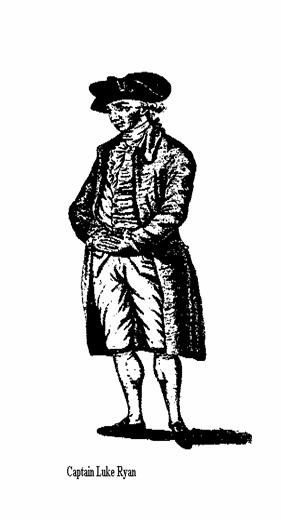
The main reason for France's financial collapse was Louis XVI's investment in the American Revolution. He had given a great deal of money to aid the Americans, including support of his own armies, and by 1787 his treasury was nearly empty. Louis also provided economic support to privateers to wreak havoc on English shipping, so that supplies from England could not reach their armies in America. One of the privateer captains which received financial support from Louis XVI was Luke Ryan. Luke Ryan left Ireland before the American Revolution to serve in the Irish Brigades. While in the Brigades, he became the commander of the privateer Black Prince, and his objective was to raid English merchant ships which provided capital to finance Louis' other military ventures. After his career in the brigades, he became a smuggler operating from the port of Rush in County Dublin. This Irish port was a major entry point for counterfeit money , books, spirits, tobacco and tea.
|
|
His ship, the Black Prince, "Was well-equipped, fast and armed for war-time activities. He commanded two ships, the Black Prince and Black Princess during the Revolutionary War period, and according to researchers such as Richard Hayes, Luke Ryan`s raids on English shipping "inflicted much damage on English commerce round the French and British coasts."[10] Ryan was captured while sailing the privateer "Cologne" flying the French flag, and four times was ordered to be executed, but reprieved at the insistence of the French. He amassed a huge fortune, 70,000 pounds, but lost it all through a fraudulent scheme masterminded by a banker in Brittany. It was in Brittany where he died in the King's Bench prison as a debtor. The French version shows that when the war ended he was released from captivity and became a French citizen assuming the title Captain 'de navires par le roi.'
|
The French Revolution ended the monarchy's absolute rule in France, and it ushered in Napoleon Bonaparte who became France's first consul. During those ten years, thousands of aristocrats, clergy, revolutionary leaders, and others including the King and Queen lost their lives on the guillotine. Among those who lost their lives were two abbess by the name of O'Ryan, and in particular, John Baptist O'Ryan was described in the journals as an 'ecclesiastic' which typified the fear the revolutionary council had of Catholic priests. Abbe O'Ryan refused to recite an oath demanded for all clergy, called the Oath of Civil Constitution in 1791. Because he declined to subject himself to blasphemy, "He was numbered among the 'refractory' priests of the time."[11] He was arrested and tried before the Revolutionary Tribunal of Bordeaux where he was sentenced to be executed as an enemy to the Republic of France. He was guillotined on February 4th, 1794.
Once Napoleon was firmly in power he led his armies to many victories on the European continent including portions of Russia. These wars became collectively known as the Neopolonic Wars, and eventually involved most of the armies of Europe including those of England. Napoleon's armies successfully defeated his neighbor's armies, and during these battles many prisoners of war were taken. How many of these were Ryans is uncertain, but official government records showed two officers by the name of O'Ryan as French prisoners of war[12]
Thomas Ryan, Lieutenant , 50 Regiment of Foot.
The records show 99 Lieutenants in Brigades.
(Illegible> Ryan, Captain, held at Valenciennes.
Irish Catholic sympathy in France increased dramatically after Napoleon embraced the command of the French government. A French official in 1796 communicated to the Irish Catholic leaders that his government was willing to send assistance, including a large quantity of arms and ammunition. In December of that year they attempted a landing at Bantry Bay, but severe weather prevented the invasion force from landing. Napoleon's efforts to assist Irish insurgents added further proof to conservative Protestant elements that the Papists were not interested in peace, but only interested in harming them and their interests. This support alarmed the established gentry, yet many continued to pursue legislative reforms to appease the growing Catholic middle-class demanding change...Change finally came, but at no small sacrifice.