

The Owen Smiths of Scotland
Scottish Smith Family
Cousland, Dalkeith, Portobello
Official Scottish Government Documents
Introduction
In 1908 Irish John Smith visited Scotland and Ireland, and while in Scotland he visited relatives who left County Monaghan to escape famine and poverty. One family he visited were descendents of Owen and Bridget Smith.
As the story goes, John Smith went to Chicago, and because the story was related seventy years later, it was thought he was attending the World’s Fair. On a whim he decided to travel to Ireland to find out how old he was. So off he went. John wrote a letter to Susan telling her he would be out of the country. Susan was none too pleased and hired a contractor to add a new addition to the house. When John came back from the British Isles he saw what she had done. Somehow he knew it was payback, and according to Frank Smith, it was never discussed again.
What we have learned is that stories get a little “fuzzy” over time, and a few facts we believe are true with this story: we believe he went to Chicago, we believe he attended a fair, and we know that Susan added a new addition. We know that there wasn’t a world’s fair in Chicago in 1908; however, in 1908 there was a international technology fair in Edinburgh, Scotland. The “fair” that Frank thought was in Chicago, was most likely the international fair held in Edinburgh.
Discovering more about this family helps us understand our own better. Owen’s parents were John Smith and Susan (Coyle) Smith. Bridget’s parents were Patrick Greenan and Margaret McCarval. These surnames are all found in Aghabog Civil Parish, County Monaghan, Ireland. The following information shows our Smith cousins as recorded in 60 years of official, Scottish records beginning in 1851. Fortunately for us the English Government did not destroy the old Scottish census records too.
What kind of records will you see here? In this document you will see information taken from Scottish census records, official marriage records, official birth and death records.
Famine in County Monaghan
The famine hit hardest in the western part of County Monaghan where land was poorest, the population highest, and alternative sources of employment were lacking. Aghabog Civil Parish, where our Smith ancestors lived, is located in the western part of County Monaghan. The famine can also be associated with economic changes as Irish agriculture was moving away from tillage crops towards livestock farming.
In Aghabog the major industry was related to the linen industry. The flax industry would have provided employment and an alternative source of income for many, but many of these land renters also depended on the potato for sustenance.
Within this backdrop we find our ancestors moving out of Ireland to different points on the globe. One branch of our family moved to Scotland. From official Scottish documents we know one branch of Smiths moved from County Monaghan to Scotland. When did they move to Scotland? It was sometime after 1846 but before 1851. Where did they go? They went to Cousland, in Midlothian County, Scotland.
Midlothian, Scotland
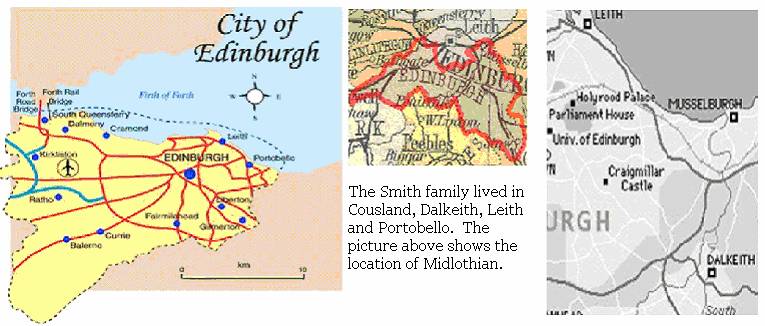
(The following description of Midlothian was taken from the ‘Gazetteer of the British Isles’ by John Bartholomew – 1887)
"Edinburghshire (or mid-Lothian), maritime co. in SE. of Scotland; is bounded E. by Haddington (or East-Lothian), Berwick, and Roxburgh; S. by Selkirk and Peebles; SW. by Lanark; and NW. by Linlithgow (or West-Lothian); coast-line, 12 miles; 231,724 ac., pop. 389,164. The surface is finely diversified. The Moorfoot Hills, a continuation of the Lammermuirs, occupy the SE.; the Pentland Hills stretch across the co. from the SW. All the streams, with the exception of the Tyne and Gala, in the E. and the SE., run to the Firth of Forth; the principal are the North Esk, the South Esk, the Water of Leith, and the Almond; the North Esk especially is noted for its picturesque scenery. The lowlands towards the Forth are the most fertile; the hilly parts of the S. are chiefly under pasture; in the W. are dairy-farms; in the vicinity of the city of Edinburgh are extensive nursery grounds and market gardens. The principal crops are oats and barley, turnips and potatoes. (For agricultural statistics, see Appendix.) The co. consists chiefly of carboniferous strata; and coal, shale, ironstone, limestone, and freestone, are extensively worked. There are valuable herring fisheries in the Firth of Forth. The mfrs. are limited; but(beyond Edinburgh and Leith) there are numerous paper mills, oil-works, and several iron foundries and brick and tile works. Gunpowder is made at Roslyn. The co. is traversed by the North British and Caledonian Rys., and by the Union Canal. It contains 28 pars, and 4 parts, the parl. burgh of Edin. (4 members, and Edin. University, with St Andrews, 1 member), the Leith Burghs (Leith, Portobello, and Musselburgh -- 1 member), and the police burghs of Bonnyrigg, Dalkeith, Loanhead, and Penicuik. It returns 1 member to Parl."
Official Scottish Records
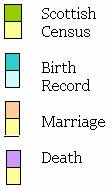
Scottish records for the Smith family have been color coded for easy reference. These are the records you will see:
1851 Scottish Census
|
Parish of Cranston |
Quond Sacra Parish of ____ |
Within the limits of the Parliamentary Burgh of _____ |
Within the limits of the Royal Burgh of ____ |
Village of Cousland |
|
|||||||||
|
No. of schedule |
Name of Street, Place, or Road and Name or No. of House |
Name and Surname of each person who abode in house on night of 39th of March 1851 |
Relation to Head of Family |
Condition |
Male Age |
Female Age |
Rank, Profession or Occupation |
Where born |
Whether Blind, or Deaf- and- Dumb
|
|||||
|
25 |
|
Owen Smith |
Head |
Mar |
37 |
|
Ag. Labor |
Ireland |
|
|||||
|
|
|
Betsie Smith |
Wife |
Mar |
|
36 |
Ag. Labor |
Ireland |
|
|||||
|
|
|
Peter Smith |
Son |
Unmar |
16 |
|
Ag. Labor |
Ireland |
|
|||||
|
|
|
Margaret Smith |
Daughter |
|
|
12 |
|
Ireland |
|
|||||
|
|
|
Susan Smith |
Daughter |
|
|
9 |
|
Ireland |
|
|||||
|
|
|
Mary Smith |
Daughter |
|
|
6 |
|
Ireland |
|
|||||
Cousland
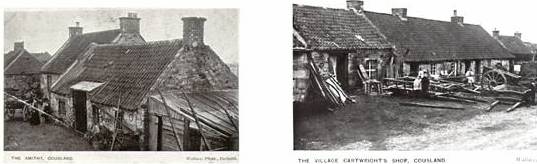
Where is Cousland? It is located in a county called Midlothian, sometimes known as Edinburghshire. Today Cousland is part of the greater Edinburgh metropolitan area. The old pictures below would have been familiar to our Smith relatives. The picture to the left shows the location of the Village Smithy, and the other picture shows the Village Cartwright’s Shop. The Village Smithy shop was old by the time this picture was taken, as it was built in 1703. An Inn also existed, which was built about 1790. There was no pub in this town, although tales of sessions in the back room of the old Cartwright shop and Smithy shop are still told. Even today there is no pub.
Birth Registration – Catherine Smith and John Smith
Marriage Registration – John Smith, Catherine Smith and Peter Smith
The Scots first began officially registering births, marriages and deaths in 1855. Between 1851 and 1861 Owen and Bridget Smith had three more children: Catharine, John and Patrick Smith. Patrick’s birth registration appears below. Unfortunately, John and Catharine were born before official records were required. Therefore, we do not have a record of their birth to add here.
Now we discuss marriage records. In some cases we could not find official records for this line of Smiths. It is possible many did not marry, or they did not marry in Scotland. Owen and Bridget had the following children: Peter, Margaret, Susan, Mary, Catherine, John, and Patrick.
Catherine Smith appears not to have married. John Smith reportedly married, but we have no record of his spouse or spouse’s name. John’s children were born near Niagara Falls, Ontario, Canada (Owen, John, Lorraine, Ruth and Charles). It is possible John moved to Canada and married there also..
Owen and Bridget’s son, Peter, married Ellen Cairnes in 1882. We could not find this record. Nothing could be found searching marriage records from 1855 to 1930. Nor could we find a pairing using surname variation such as Cairnes, Carnes, Kearns, etc. Again, it is possible Peter married Ellen in another country.
Some of Patrick Smith’s children immigrated to the America (Patrick Jr., Bridget, James and Thomas).
We do not think Mary Smith ever married.
1856 Birth Registration – Patrick Smith
1856, Births in the Parish of Cranston in the County of Edinburgh, page 2
|
No. |
Surname, and Name (if given) Name, when given or altered |
When and Where Born, with Hour Of Birth |
Sex |
Name, Surname And Rank or Profession of Father |
Name, and Maiden Surnames of Mother |
Signature, Qualifications, And Residences of Informant, if out of the House in which the Birth Occurred. |
When and Where Registered, and Signature of Registrar |
|
6 |
Smith Patrick |
1856 March Second 4h PM Cousland |
M |
Owen Smith Labourer |
Bridget Smith Maiden Name Greenan |
Owen Smith His ‘x’ Mark, Father (not present) Alexander Murray Registrar Witness |
1856 March 20th At Cranston
Alexander Murray Registrar |
This is the only birth registration we could find for any of Owen Smith and Bridget Greenan’s children.
1858 Marriage Registration – Francis Goodwine and Margaret Smith
1858 Marriages in the Parish of Dalkeith in the County of Edinburgh, page 20
|
No. |
When, Where, and How Married |
Signatures of Parties |
Age |
Residence |
Rank or Profession, and Condition (whether Bachelor or Widower, Spinster or Widow.) Relationship of Parties (if any) |
Name, Surname, and Rank or Profession Of Father. Name, and Maiden Surname of Mother. |
If a regular Marriage, Signatures of Officiating Minister and Witnesses |
If irregular, date of Extract Sentence Of Conviction, or Deerce of Declarator, and Court |
|
39 |
On the Eighteenth Day of October 1858 at St. Davids Church Dalkeith. Marriage Was solemnized Between us Ascending to the Forms of the Holy Catholic Church |
Signed, Francis Goodwine His ‘x’ mark William McKay
Signed Margaret Smith Her ‘x’ mark William McKay |
22
19 |
Dalkeith
Cousland |
Laborer
Spinster |
Michael Goodwine Labourer Mary McCabe
Owen Smith Labourer Bridget Greenan |
Signed William MacKay Missionary Apostolic Signed John ‘?’ Witness Susan Smith Witness |
|
This was one of the few marriage records we could find for this family. In the 1871 Scottish census Margaret Smith Goodwin(e) and her children were living with Owen and Bridget Smith. Margaret married Francis Goodwine. The surname Goodwin can frequently be seen in County Monaghan, Ireland. Please note that Francis Goodwine’s mother was born Mary McCabe. Later in 1881 we found one Michael McCabe living with the Francis and Margaret Goodwin family. Michael McCabe was from Ireland.
1859 Birth Registration – Louisa Jane Hamilton King, later known as Louisa Smith
1859, Births in the Parish of Dalkeith in the County of Edinburgh, page 2
|
No. |
Surname, and Name (if given) Name, when given or altered |
When and Where Born, with Hour Of Birth |
Sex |
Name, Surname And Rank or Profession of Father |
Name, and Maiden Surnames of Mother |
Signature, Qualifications, And Residences of Informant, if out of the House in which the Birth Occurred. |
When and Where Registered, and Signature of Registrar |
|
231 |
King Louisa Jane Hamilton |
1859 Twenty second November 7 h 0 m AM Cowdenfort Dalkeith |
F |
Thomas King
Coal Miner |
Margaret King Maiden name Struthers |
Thomas King Father Present |
1859 December 5th At Dalkeith Wm Banie Registrar |
Now you may wonder why we added this record. In our website we have five immigration records for Smiths who immigrated from Scotland to America. One of these immigrants was Louisa Smith. Louisa married Patrick Smith, Sr. Patrick was born in 1856 and his birth record appeared earlier in this paper. They had many children, and at least four of their children lived and died in Wisconsin.
1861 Scottish Census
|
Page 8] The undermentioned Houses are situate within the Boundaries of the |
||||||||||||||||
|
Parish of Cranston |
Quond Sacra Parish of |
Parliamentary Burgh of |
Royal Burgh of |
Town of |
Village of Cousland |
|||||||||||
|
No. of Schedule |
Road, Street &c., and No. or Name of House |
Houses inhabited |
Houses uninhabited (U.), or Building (B) |
Name and Surname of each Person. |
Relation to Head of Family |
Condition |
Age of Male |
Age of Female |
Rank, Profession, or Occupation |
Where Born |
*AA
|
*BB |
*CC |
|||
|
|
30 Cousland Village |
|
1 U |
|
|
|
|
|
|
|
|
|
|
|||
|
33 |
31 Cousland Village |
1 |
|
Owen Smith |
Head |
Mar |
50 |
|
Limework Labor |
Ireland Monaghan |
|
|
1 |
|||
|
|
|
|
|
Bridget Smith |
Wife |
Mar. |
- |
46 |
Wife of Limework Laborer |
Ireland Monaghan |
|
|
|
|||
|
|
|
|
|
Peter Smith |
Son |
Un. |
24 |
|
Ploughman |
Ireland Monaghan |
|
|
|
|||
|
|
|
|
|
Mary Smith |
Daughter |
Un. |
- |
17 |
Ag. Labor |
Ireland Monaghan |
|
|
|
|||
|
|
|
|
|
Catherine Smith |
Daughter |
|
|
10 |
Scholar |
Edinburgh Cousland |
|
1 |
|
|||
|
|
|
|
|
John Smith |
Son |
|
7 |
|
Scholar |
Edinburgh Cousland |
|
1 |
|
|||
|
|
|
|
|
Patrick Smith |
Son |
|
5 |
|
|
Edinburgh Cousland |
|
|
|
|||
|
|
|
|
|
|
|
|
|
|
|
|
|
|
|
|||
|
|
32 Cousland Village |
|
|
House used as a barn |
|
|
|
|
|
|
|
|
|
|||
*AA Whether Blind, or Deaf and Dumb.
*BB No. of Children from 5 to 15 attending School.
*CC No. of Rooms with one or more Windows.
Cousland Limeworks
In the last census we see that Owen Smith was working in the Limeworks. Later, Patrick Smith Sr. could be seen employed in the same industry.
There was a lot of carboniferous limestone south of the River Forth, and this area was one of the oldest and most prolific lime producing districts of Scotland. Before 1750 lime production in this area was ‘small potatoes’. Medieval builders regarded lime as an essential element for binding masonry and lightening interiors. Roads, gas and iron works and the pottery industry made other demands. By 1912 around 800 men were employed in the Lothian limeworks, working 8 mines and 63 quarries. Cousland had 4 quarries, 3 mines and 7 kilns.
1871 Scottish Census
|
Page 2] The undermentioned Houses are situate within the Boundaries of the |
|||||||||||||||||
|
Civil Parish of Cranstown |
Quond Sacra Parish of |
Parliamentary Burgh of Edinburgh |
Royal Burgh of |
Town of |
Village of Cousland |
||||||||||||
|
No. of Schedule |
Road, Street, &c., and No. or Name of House |
Houses inhabited |
Houses uninhabited (U.), or Building (B) |
Name and Surname of each Person. |
Relation to Head of Family |
Condition |
Age of Male |
Age of Female |
Rank, Profession, or Occupation |
Where Born |
*AA
|
*BB |
*CC |
||||
|
11 |
Cousland Village |
1 |
|
Owen Smith |
Head |
Mar. |
60 |
|
Quarryman (Lime) |
Ireland |
|
|
1 |
||||
|
|
|
|
|
Bridget Smith |
Wife |
Mar. |
|
54 |
|
Ireland |
|
|
|
||||
|
|
|
|
|
Patrick Smith |
Son |
|
15 |
|
Quarryman (Lime) |
Edinburghshire Cranston |
|
|
|
||||
|
|
|
|
|
Margaret Goodwin |
Daughter |
Mar. |
|
31 |
Ag. Labr. |
Ireland |
|
|
|
||||
|
|
|
|
|
Francis Goodwin |
Grandson |
|
11 |
|
Scholar |
Edinburgshire Dalkeith |
|
1 |
|
||||
|
|
|
|
|
Peter Goodwin |
Grandson |
|
9 |
|
Scholar |
Edinburghshire Leith |
|
1 |
|
||||
|
|
|
|
|
Michael Goodwin |
Grandson |
|
4 |
|
|
Edinburghshire Leith |
|
|
|
||||
*AA Whether Deaf and Dumb, Blind, Imbecile or Idiot, Lunatic
*BB No. of Children from 5 to 15 attending School.
*CC No. of Rooms with one or more Windows.
Dalkeith
By 1881 Owen and Bridget Smith moved to Dalkeith, possibly to be nearer grandchildren and other family members. The following information comes from a website describing the Dalkeith area:
Dalkeith is situated 6 miles (10 Kilometers) south of Edinburgh, the town of Dalkeith lies on a ridge between the rivers North and South Esk. Created a burgh of barony (1401) and burgh of regality (1540) while under the control of the earls of Morton, Dalkeith passed to the Buccleuchs in the mid-17th century. The settlement, which grew southwestwards from its 12th-century castle, had in the 17th century one of Scotland’s largest markets in its exceptionally broad High Street. In 1831 Dalkeith was linked to Edinburgh by a railway line that transported coal, minerals and agricultural produce and two decades later, in 1853, a Corn Exchange, the largest interior grain market in Scotland, was built. One landmark there is the Dalkeith House, which is now leased to the University of Wisconsin and the estate forms a County Park extending to 850 acres.